


1. Why industrial laundry safe printing matters for Surrey workwear
Crews in Metro Vancouver beat up their gear. Prints take the hit first. High heat, strong alkalinity, and heavy mechanical action can wreck conventional decoration fast, which leads to cracked logos and dull hi-vis panels.
The CDC describes common plant formulas at about 160°F (71°C) for 25 minutes, or lower temperatures with stronger chemistry. That is harsher than home laundry by a wide margin. So a mark that survives a weekend wash may still fail at the plant.
Safety is on the line. WorkSafeBC guidance based on CSA Z96 says logos or patches must not reduce the required fluorescent or retroreflective areas. If a print fades or delaminates, visibility can drop below the standard. That creates risk.
Set expectations before rollout. Define the durability target, agree on a test method, then approve production only after wash testing. If you need a starting point for Surrey programs, explore industrial laundry safe screen printing to see how we spec, print, and verify for industrial cycles.
Key takeaway: Industrial cycles are harsher than home. Treat the print like a critical component, not an afterthought.
2. What “industrial laundry safe” means: standards and test methods
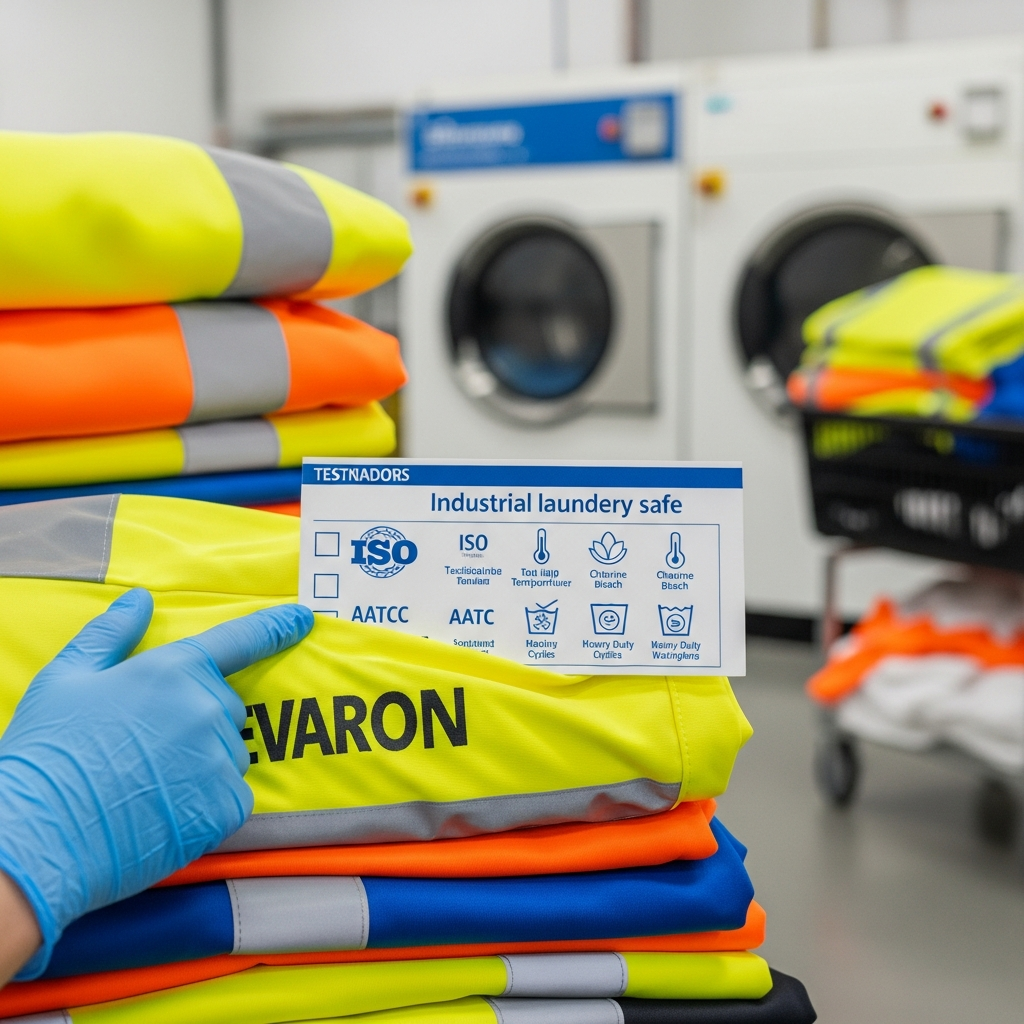
Industrial laundering is more than hot water. It often includes a high-alkali break, stronger detergents or oxidizers, bigger loads that increase mechanical action, and hot finishing steps. Home results do not predict that stress. You need a standard method.
ISO 15797 is the reference for workwear intended for industrial laundering. It defines washing and finishing procedures for assessment. Those procedures simulate real plant conditions, including options such as tunnel finishing, pressing, tumble drying, and specified wash temperatures. That alignment matters for Surrey-area programs.
How do “cycles passed” translate to real life? Treat the test as a controlled baseline. If a print stack completes an agreed ISO 15797 procedure for a set number of cycles without unacceptable change, you can set an expectation for field service. But the standard defines procedures, not pass or fail criteria. Define success up front: acceptable color shift, no cracking, adhesion intact, and visibility maintained.
Use ISO 15797 to compare systems apples-to-apples, then confirm with a pilot in your actual laundry.
3. Ink systems that survive industrial washes: pros and cons
Choosing the right ink is the first durability decision. Ink chemistry controls resistance to heat, alkalinity, oxidizers, and abrasion. Price and press speed matter. Failure in the wash costs more than ink.
-
Plastisol: Modern low-bleed and high-opacity plastisols can perform well on polyester and blends when fully cured. Many systems specify full cure at about 320°F (160°C) measured in the ink film, not just dryer air. Watch for dye migration on polyester and potential brittleness with very heavy deposits. Many plastisol makers also caution against chlorine bleach or industrial laundering without prior testing.
-
Silicone inks: Excellent elasticity and resistance to heat and chemicals make silicone a strong candidate for industrial laundering. Costs are higher and cure windows are specific. For hi-vis polyester and stretch fabrics, the payoff is durability.
-
Water-based, crosslinked: These inks offer a soft hand and a greener perception. With a crosslinker additive, some systems document better performance under severe washing. Precision curing is non-negotiable. Strong alkali or oxidizers can still challenge the film unless the system is engineered for it.
-
Ancillary solutions: Barrier or gray blocker bases reduce dye migration on polyester. Purpose-built high-build underbases and post-cure additives can increase resistance.
If you are planning workwear screen printing in Surrey at scale, align ink chemistry with the exact fabric and laundry spec. Or risk rework later. For local advice and production capacity, see screen printing in Surrey.
4. Curing for durability: time, temperature, and verification
Under-cure is the fastest way to fail an industrial wash. Over-cure can embrittle prints or trigger dye migration. The sweet spot is narrow. Follow the ink maker’s cure temperature and dwell time for the specific ink and fabric.
Do not trust the dryer display. Measure the print itself. The ink film must reach the recommended cure temperature, so use temperature probes or thermo strips on test prints and at multiple positions on the belt. Check both light and dark garments, and re-verify when you change lot numbers or ink colors.
Run quick shop checks: a stretch test, a controlled solvent rub, then a small-batch wash test. Many manufacturers recommend wash testing on the real fabric under expected conditions before release. Document your recipe: substrate color, blocker or underbase, mesh, squeegee, flash settings, and dryer parameters. Then lock it. Repeatability drives success in large safety programs and in industrial laundry safe screen printing.
Print, cure, measure, wash-test, repeat. That loop reduces surprises.
For site-specific process controls or a pre-production run, ask about custom workwear printing.
5. Garment and design choices that boost industrial wash performance
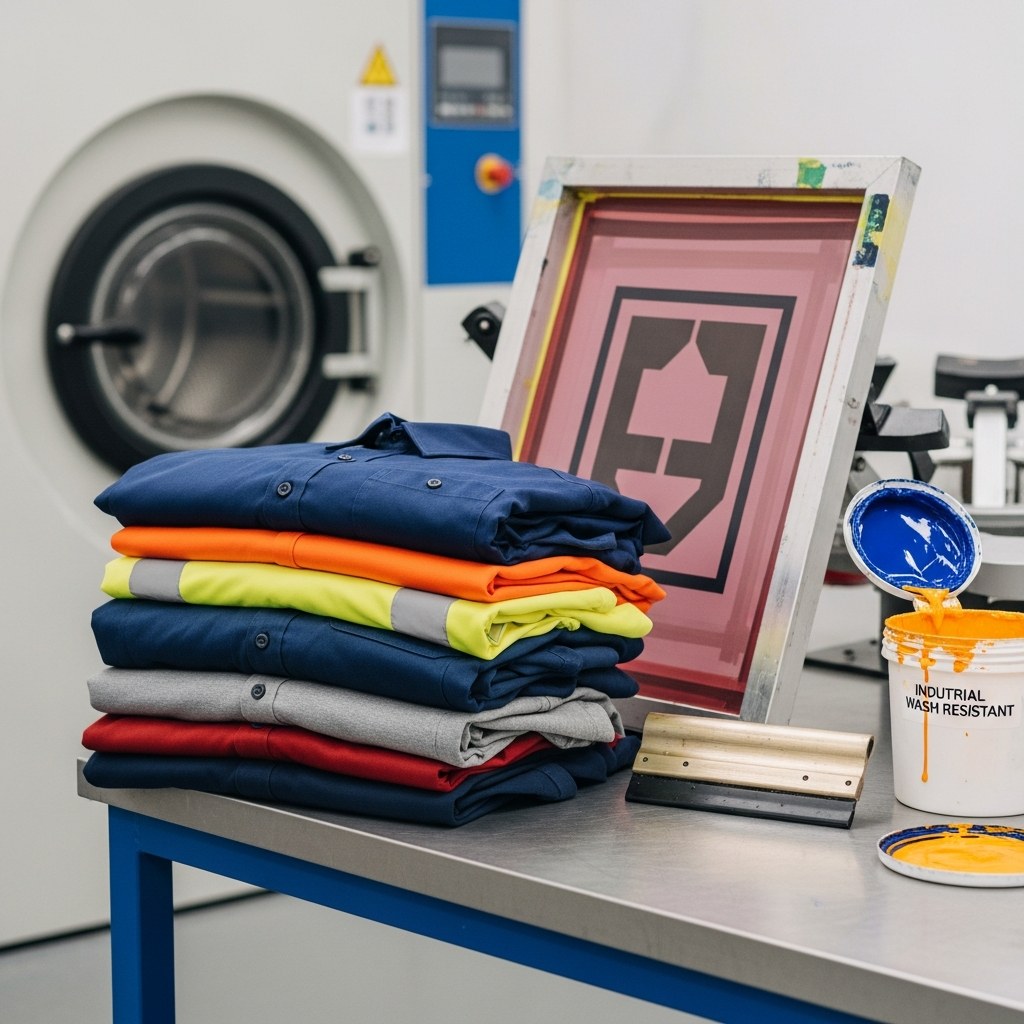
Ink cannot fix a poor fabric match. Choose textiles that tolerate higher heat and chemistry, like stable polyester or poly-cotton blends designed for workwear. Some finishes or coatings can reduce print adhesion. FR garments require special care.
FR apparel must not lose protective performance after decoration. Many FR brands advise that screen printing inks be flame resistant and that embellishments be evaluated to the relevant standard, such as NFPA 2112. Always verify on the actual FR fabric before rollout. No shortcuts.
Hi-vis designs need careful placement. WorkSafeBC, referencing CSA Z96, allows identification logos only if they do not reduce fluorescent background or retroreflective areas below the minimum. Coordinate logo placement so reflective trims stay unobstructed, and avoid stress across seams that can cause delamination.
Polyester and neon fabrics can bleed at elevated cure temperatures. Technical bulletins often advise low-cure, low-bleed inks and a gray blocker underbase to combat migration. Keep the art practical. Favor bolder linework, adequate deposit, and continuous shapes over fragile micro-halftones. Those tiny dots crack under heavy mechanical action.
For FR and hi-vis, durability and compliance travel together. Get both right. Explore FR workwear printing for guidance.
6. Align industrial laundry variables with your launderer
Your print spec must match the plant’s formula. Align early with your partner on wash temperature, alkalinity, oxidizers, and finishing heat. The CDC notes two common routes in plants: thermal disinfection at about 160°F (71°C) for 25 minutes, or lower temperatures with suitable chemical disinfection. Each path stresses prints differently.
Industrial processes often push pH high during the break bath, then neutralize in a souring step to roughly pH 5 to 6. That swing is tough on some inks. Mechanical action, load size, and extraction speeds increase abrasion and flexing. Finishing methods such as tunnel finishing, pressing, or hot tumble drying can add a post-exposure that changes gloss and can embrittle marginal cures.
Write it down. Document acceptable ranges for temperature, pH, oxidizer use, and finishing temperatures. Note any bleach restrictions by print type. Build an escalation path if failures appear. Quick photos, retained samples, and lot numbers help you and the plant troubleshoot fast.
Agree on the wash recipe, then print to that recipe. Not the other way around.
7. Care labeling that communicates limits
Good prints fail when care is unclear. Translate technical limits into clear instructions and symbols, then put them where launderers will see them. Simple beats clever.
Use the ISO 3758 care labeling system to communicate washing, bleaching, drying, and ironing. Pair symbols with plain language. If your print stack is not compatible with chlorine bleach, say so. Many plastisol makers caution against chlorine bleach because it can damage the print. For industrial processes, include the maximum finishing temperature and any detergent requirements if the ink system demands them.
Give the laundry vendor a one-page spec. Include garment fiber content, print system, target cure, and the acceptable wash and finishing ranges. Add a visible identifier, such as an inside-neck code or a small data matrix near the side seam, that ties each garment to the approved spec. When plants run mixed loads, your garments still get treated within limits.
Clear labels reduce rewash, rework, and warranty calls.
8. Quality assurance: test before rollout
Trust the process, but verify on your fabric and your laundry formula. A pilot is faster than a replacement program.
-
Pre-production pilot: Print a small batch with the final ink stack. Run the garments through your actual laundry partner’s process to observe real-world wear. Capture the wash recipe and finishing temperatures.
-
Standard or lab testing: Use ISO 15797 where possible to align with industrial conditions. For quick screening, run AATCC TM61 to evaluate color change under domestic or commercial conditions, so you can compare inks or art setups quickly.
-
Evaluate the right things: Check adhesion, cracking, color change, and gloss loss. Many labs use the AATCC gray scales (EP1 for color change and EP2 for staining) that rate from 5, which is no visible change, to 1, which is severe. Set acceptance criteria before you start.
-
Traceability: Record ink lot numbers, mesh, flash times, dryer settings, and garment lot. Keep retains for any disputed pieces.
If you need third-party data or a structured pilot, ask about industrial wash testing services.
9. Spec and RFP checklist for facility managers and safety coordinators
Use this checklist to align vendors and launderers, then tie it to your purchase terms.
-
Garment details: fiber content, color, any FR requirement, hi-vis class, and coatings such as DWR or PU that can reduce adhesion.
-
Decoration spec: ink family, blocker use on polyester, target cure temperature and dwell time, print locations, and acceptable hand or feel.
-
Durability target: minimum cycles and the method, for example ISO 15797 workwear testing. Because ISO 15797 defines procedures and not pass or fail criteria, state the number of cycles and what counts as acceptable change.
-
Laundry parameters: maximum wash temperature, oxidizer tolerance, pH or alkalinity range, and finishing temperature. Define who is responsible if the process runs outside the agreed tolerances.
-
Evidence and approval: require sample testing data, including any AATCC TM61 screening and visual ratings using EP1 and EP2, before issuing a blanket PO.
Clear specs shorten lead times and reduce disputes.
10. Budget and lead time implications
Durability has a cost profile. Plan for it and you will avoid overruns later.
-
Ink choices: Silicone and specialty blocker systems usually cost more. They can also slow press speed because they need specific bases, higher deposits, or longer flashes.
-
Curing and verification: Longer dwell times, more test strikes, and confirmation washes add production time. Shops will slow the belt, run test pieces, and measure ink-film temperatures. That time protects your contract.
-
Testing budget: Preventive testing is almost always cheaper than mid-contract replacement. A small pilot lowers risk, informs your RFP, and keeps workers in compliant gear.
If timing is tight, stage deliveries. Approve a pilot, then release the bulk once the data hits your targets. It is faster than reprinting an entire order.
11. FAQs: bleach, reflective trims, and home vs. industrial washing
-
Can we use chlorine bleach in our plant? It depends on the ink system and the garment. The CDC says bleach may be used for disinfection when appropriate for the textile, and users should follow the manufacturer’s instructions. Many plastisol makers caution against chlorine bleach for printed garments. Align chemistry with your ink spec, then test before approval.
-
Do reflective heat transfers hold up to industrial washes? Some do, within limits. EN ISO 20471 requires retroreflective materials on high-visibility garments to meet performance after specified conditioning such as washing. Manufacturers publish care limits and cleaning cycles for their trims. Choose sewing when cycle counts exceed the transfer’s published range, or verify the transfer to your plant’s cycle.
-
Will home washing data predict industrial performance? Usually not. Industrial cycles often use high alkalinity and higher mechanical action, and they may use either 160°F thermal disinfection or low-temperature washing with stronger chemistry. Home results can mislead.
-
How many cycles should we expect before reorder? Set a target based on testing. Use ISO 15797 for procedure alignment, then confirm with your plant pilot. Tie acceptance to visible change, adhesion, and visibility for hi-vis, not just a number.
Make your Surrey workwear program industrial-laundry ready
Durable prints start with the right chemistry, precise curing, and a laundry spec you and your plant can run. Then you test. That sequence keeps workwear readable, compliant, and in service longer.
If you are building a Surrey rollout, we can help you pick the ink system, plan curing windows, and coordinate with your launderer. Ask for samples or a short pilot batch that reflects your exact site conditions. When you are ready, request a quote and we will map the print stack to your spec for true industrial laundry safe screen printing.

